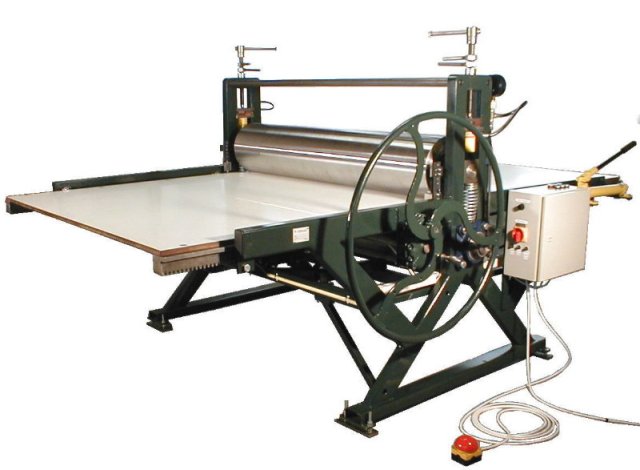
Technical data of the etching press JZE-125

台面尺寸

136 x 250 厘米


顶辊直径

30 厘米


工作板厚度

2 厘米


辊筒的壁厚

3,2 厘米


印刷尺寸:

底辊直径

32 厘米


- 长度(侧架)

240 厘米


压力机的作业高度

88 厘米


- 宽度(含手轮)

185 厘米


钢制侧框的厚度

5 厘米


- 高度

160 厘米


床身与上辊之间的最大间隙

10 厘米


辊筒长度

125 厘米


压力主轴的螺纹(公制)

M 30

压机的重量

1550 千克


手轮直径

92 厘米


轴承座中的轴直径

8 厘米


移动压力机所需的最小门宽(不含减速箱和电气柜)

171 厘米

系统所需的电压(由变频器转换为变频三相电源)

230伏,单相交流电


可变打印速度

1-6 厘米/秒


动力电动机

1000瓦

货箱的重量

1550 千克


The etching presses in the JZE series are very heavily built. These are the characteristics;

  • 驱动的不是辊筒,而是印刷台。这当然使技术结构更加复杂,但优点是完全排除了“打滑”的可能性。印刷台通过两根“齿条”进行驱动,每侧各一根。这些齿条由一个齿轮传动系统驱动。.
  • 与我们所有的蚀刻机一样,上辊由压力弹簧支撑。当松开压力螺杆时,上辊会随之升起,这在印刷木刻和亚麻油版画时非常方便.
  • A hydraulic cylinder is located under the pressure spindles. These cylinders are connected to each other by means of a hydraulic line and to a hand pump. This hand pump is mounted on the side frame on the side of the hand wheel. This system makes "pressurizing" of the upper roller very easy. The "normal" pressure spindles are used to move the upper roller vertically. As soon as the upper roller is in the correct position, the roller can be pressurized with the hydraulic pump. The maximum pressure force per side is 10,000 kg. This means that the roller exerts a total maximum force of 20 tonnes (20,000 kg). The exact force can be read on the pressure gauge. The two hydraulic cylinders are connected to each other as standard, so that the pressure on both sides of the press is always the same. With this hydraulic pressure and measurement system it is easy to simulate the conditions of a previous printing run, if these have been recorded.
  • The presses are equipped with light cells. If the light path is interrupted (for example by the hand of the printmaker), the drive stops immediately.
  • The presses can always be driven manually, even at any time, and without interrupting printing. Shifting a clutch switches the motor drive off and the hand drive on and vice versa. This is very practical during "proofing".
  • The presses are driven by an electric motor with a variable speed. The motor is powered by direct current and electronically controlled. The power supply for this system can be 220 Volts, 110 Volts or 380 Volts (alternating current). (Specify when ordering).
  • These presses are equipped with a "slip coupling". Suppose someone accidentally leaves a screwdriver or the like on the bed. This can lead to damage to the rollers. To prevent such damage as much as possible, the slip coupling is built in. As soon as the bed is blocked in motion, the coupling is activated and the bed stops. The "torque" at which the clutch will slip can and must be set by the printmaker.
  • The four "feet" of the press have an adjustment option. This allows the press to be accurately adjusted to the floor. It is important to level the press as much as possible.

Click on the images below for more information:

Rear side of the JZE etching press, with drive system, hydraulic cylinders and bearing blocks.
Click on the image for a larger picture

Steel box with electric components and hydraulic handpump.
Click on the image for a larger picture

Electric motor, worm-gear-system, and coupling to switch between manual and electric mode.
Click on the image for a larger picture

Rear side of the press with the big gear wheel with the built in torque limiter. The torque to activate the coupling is adjustable. This is important for the safety of the press. Damage to the press, by "a forgotten tool on the bed" can be avoided in this way.
Click on the image for a larger picture

Position of the photo-electric cell. The infra red light is bounced back by the reflector, and if interrupted, will immediately stop the machine. (the drive system goes even in reverse during about one second)
Click on the image for a larger picture

Reflector oppostite the photo-electric cell.
Click on the image for a larger picture

Detail of the hand wheel, pressure gauge and hydraulic cylinder, of the JZE-etching press.
Click on the image for a larger picture

Electric main circuit of the JZE-etching press
Click on the image for a larger picture

Electric control circuit of the JZE-etching press
Click on the image for a larger picture

Option; de JZE-etching press on swivel wheels
Click on the image for a larger picture

Option; JZE-etching press with a rotating blanket system. The image shows a JZE press with a rotating blanket system. However this system only allows one layer of blankets
Click on the image for a larger picture